Estimating Software vs. Project Management Software: Where the Line Actually Falls
Estimating software and project management software can sometimes get lumped together, but they're built to answer two different questions: what should this job cost, and how is this job actually going.
Article written by
Zack Bedingfield
Estimating software and project management software can sometimes get lumped together, but they're built to answer two different questions: what should this job cost, and how is this job actually going. The line between them isn't a feature checklist, it's the moment a signed estimate turns into a budget.
What Estimating Software Is Actually For
At the most basic level, estimating software performs a purely pre-construction function: figuring out how much a job costs so you can win the bid and make money on it. Accuracy matters supremely here (underpricing sends contractors broke), but "accuracy" is more complicated than it sounds.
Two estimators can price the exact same set of drawings and land on legitimately different, both-correct numbers. That's not a math error. Estimating isn't a purely technical exercise, it's a business decision wearing a technical process as a costume. The variance comes from things that never show up in a takeoff: how badly you want the job, what risk you're willing to carry versus push back to the client, how tight your cost library is, and what assumptions you made about scope that was never fully specified in the drawings.
This is exactly why inclusions and exclusions matter as much as the number itself. A price without documented assumptions isn't more accurate, it's just quietly optimistic. Good estimating software treats this as core functionality, because that document is what actually gets negotiated against and eventually signed into a contract.
Operationally, solid estimating software is doing three things: extracting scope from a plan, performing a takeoff, and organizing that into a formal, client-ready estimate. The best of them go further: flagging confidence levels on individual measurements (a foundation depth that's explicitly stated on the drawings versus one that had to be inferred, for example) and citing exactly which sheet a number came from.
That's a real leap forward from a blank spreadsheet, and it deserves credit as such.
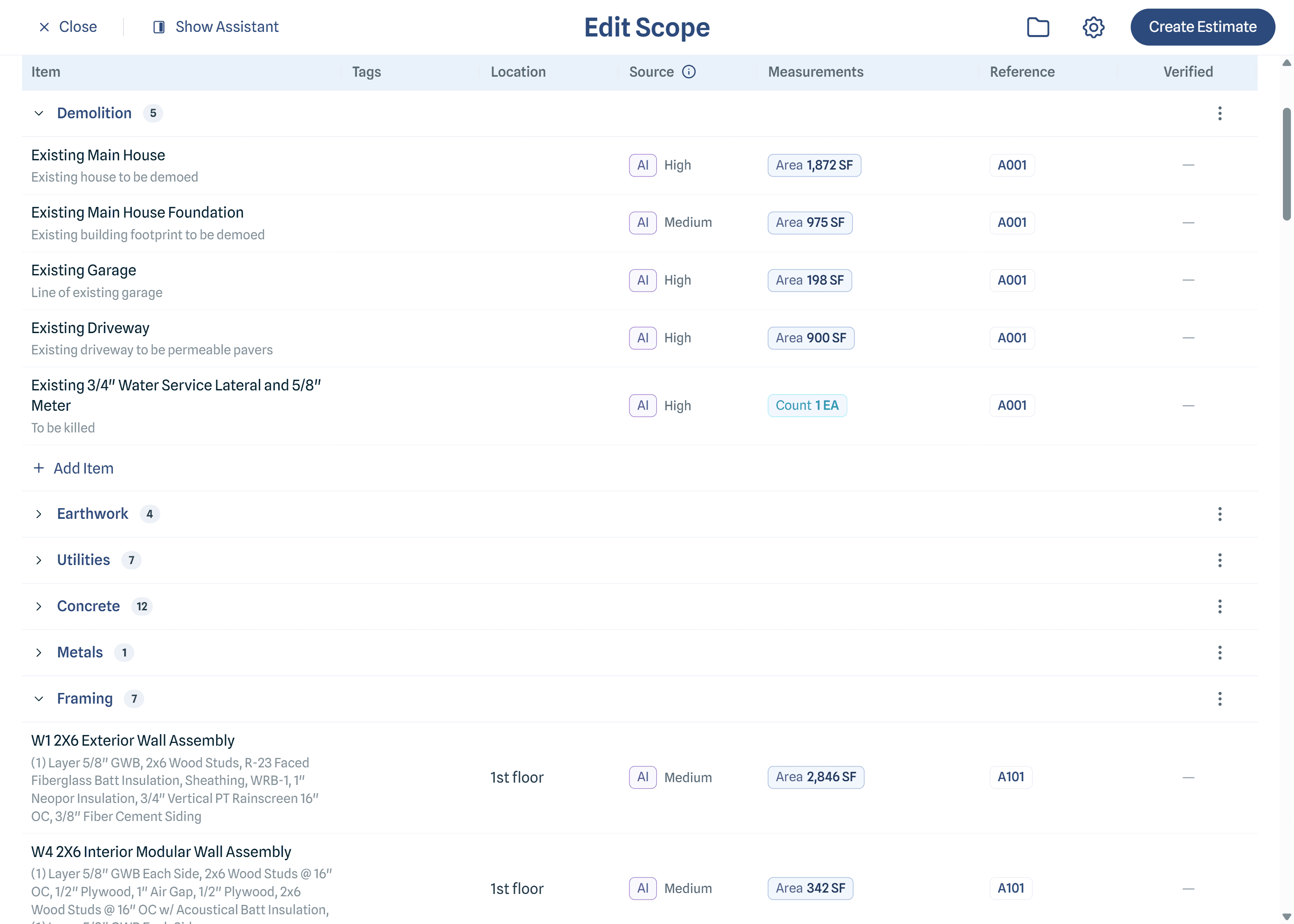
What the Software Does Well, and Precisely Where the Human Has to Step Back In
Here's the part that matters most, and it's easy to miss if you only look at the final output: the software's job is to surface uncertainty, not resolve it.
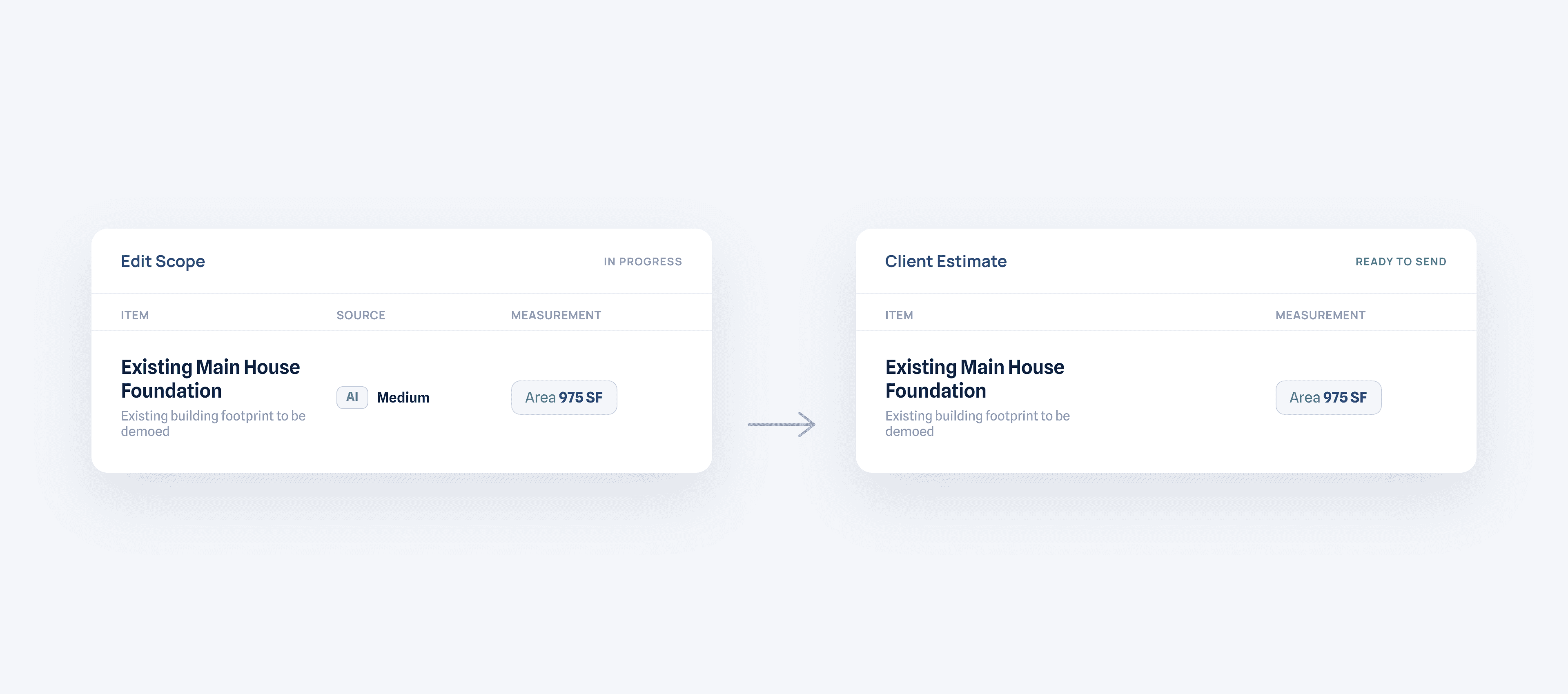
In practice, this shows up as a flagged assumption at the scope stage: something like "assumed an 18-inch trenching depth because it wasn't dimensioned on the drawings," tagged as low confidence. That's the software doing exactly what it should, telling you where it had to guess. The problem is what happens next. By the time that same item shows up in the finished estimate, the flag is gone. The assumption has quietly hardened into a stated fact, cited to a sheet number.
That's not a tool failure, it's a structural reality. Software can tell you that something is uncertain. It cannot decide what to do about it, because that decision is a business judgment, not a data extraction problem: do you price the uncertainty in as risk, exclude it and push it back to the client, or accept it because you want the relationship and you're comfortable eating it? None of those are calculations. They're calls only an estimator can make, because they depend on how much you want the job, how the client will react to seeing a qualification, and what you know about this specific site that isn't on any drawing.
This is the real difference between estimating software and an estimator: the software can hand you a clean, well-organized list of everything it wasn't sure about. Whether that uncertainty makes it into the client-facing document as a qualification, gets priced in as contingency, or disappears into a confident-looking number is still entirely up to the person running it. Skip that step, and you've automated the part of estimating that was never the dangerous part, while quietly deleting the flag on the part that actually loses money.
If you're weighing whether AI-assisted scope extraction changes this equation, what AI construction estimating actually is and how AI estimating differs from AI takeoff both cover this in more depth.
Where the Line Blurs, and Why It's Financially Significant, Not Just Convenient
The moment an estimate gets accepted and signed, it's supposed to become your budget. This is where estimating software's job ends and project management software's job begins: tracking performance against that budget as the job actually unfolds.
This isn't just an operational nicety, it's where money actually gets made or lost. If the platform managing the build is disconnected from the platform that produced the estimate, tracking becomes basically impossible, because you're comparing progress against nothing concrete. Schedule creep is the clearest example: a job's gross profit divided by expected weeks of billing tells you your real profit rate, and if the schedule slips, that rate drops, but only a connected system makes that visible in time to do something about it, rather than surfacing it as a bad number at year-end, well after the budget has already been blown.
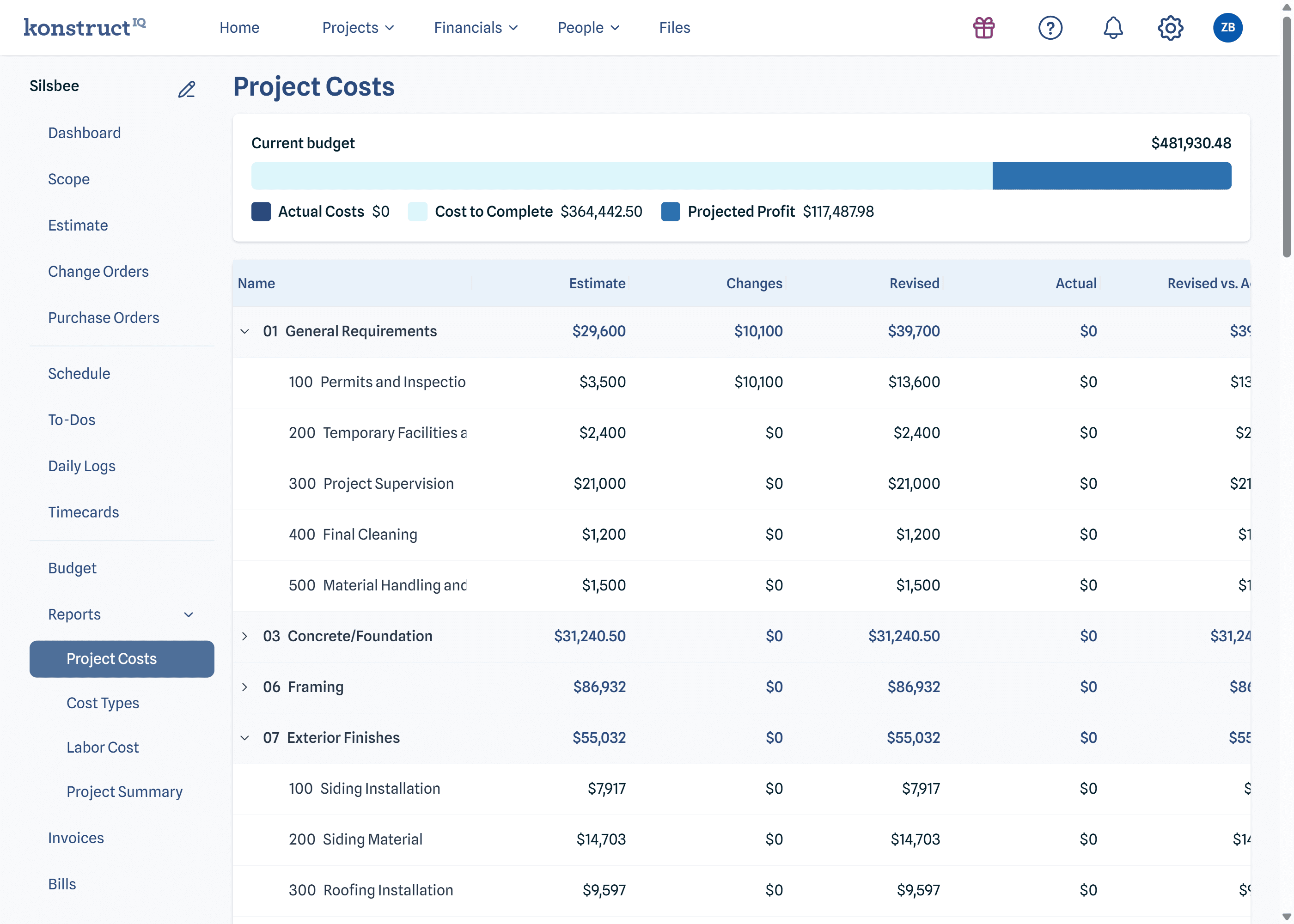
What Bundled Platforms Add Beyond Speed
Platforms that handle both pre-construction and project management aren't just saving you from re-entering data. The connection creates value in a few specific ways:
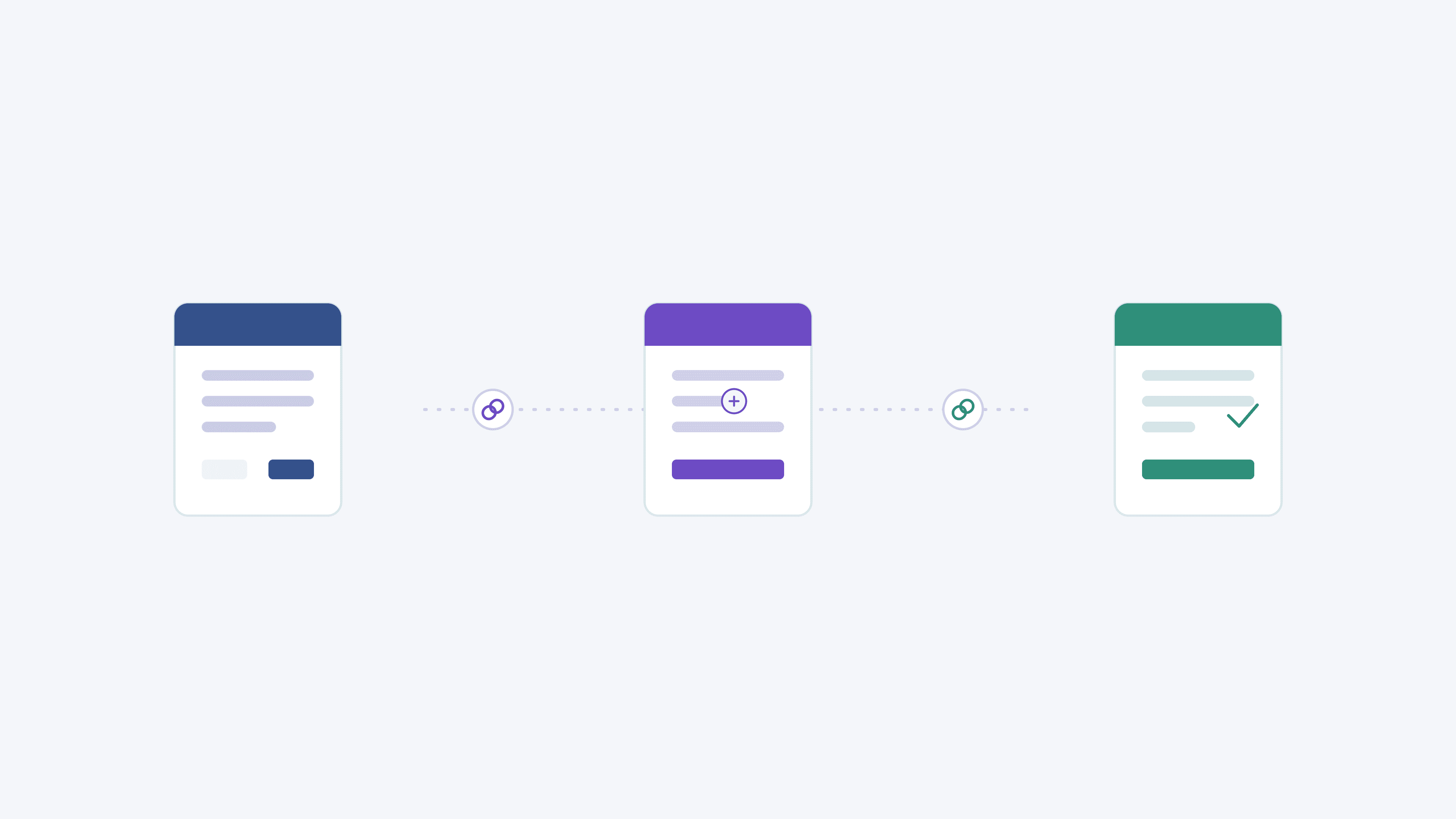
Change orders and invoices stay tied to the original scope and price, so when scope changes, you're updating the actual number you're managing against, not generating a new invoice disconnected from the estimate that justified it. (We covered the change-order side of this directly in handling last-minute change orders.)
The handoff from signed estimate to active job is where a lot of client trust gets built or lost. A visible, dated pipeline prevents the kind of communication vacuum where clients fill gaps with their own assumptions.
You get a single source of truth for what you actually agreed to, which matters most when disputes or change requests come up later.
The Decision Framework
Rather than a feature comparison, the real question is twofold: how much of your business lives on each side of the signed-estimate line, and how much you trust yourself to catch what the software quietly resolves on your behalf.
If you're a subcontractor or trade contractor bidding constantly, estimating-focused software with strong assumption-tracking may be all you need, but build in a review step where someone explicitly decides what happens to every flagged assumption before it goes to a client.
If you're a general contractor running the full lifecycle, the bundled platforms save you from losing the thread between what you priced and what you're managing, but the same rule applies at the estimate stage: the software organizing your uncertainty is not the same as someone deciding what to do with it. (For a closer look at how KonstructIQ's bundled approach stacks up against standalone tools, see how it compares to Buildertrend and JobTread.)