What Is AI Construction Estimating? (vs. Traditional)
Article written by
Zack Bedingfield
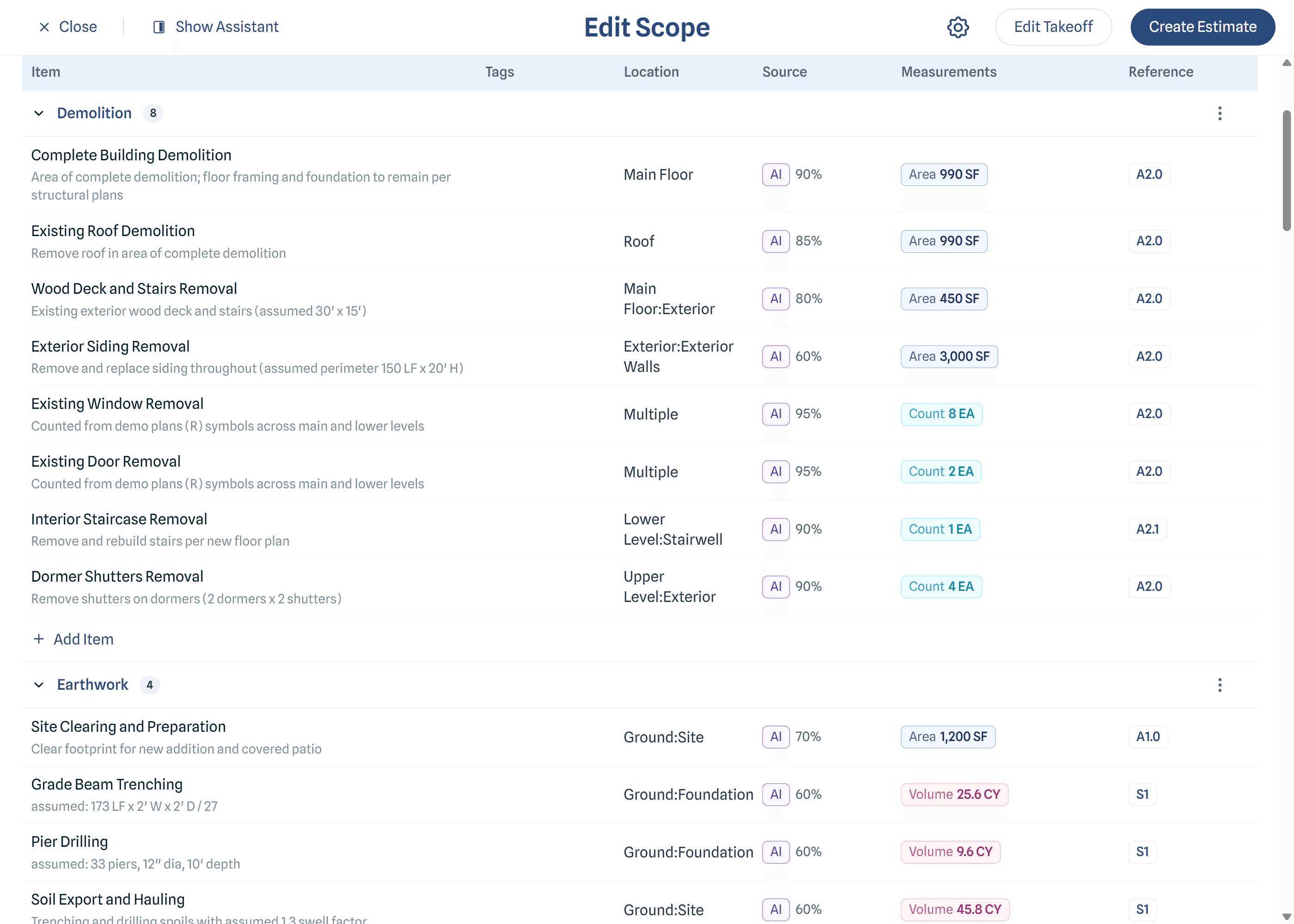
AI construction estimating uses artificial intelligence to convert a project’s scope, quantities, measurements, and specifications, typically pulled from an AI takeoff, into priced line items, pulling from cost data and pricing catalogs rather than requiring a person to price every item by hand. It speeds up the first draft of an estimate significantly, but it doesn’t remove the need for a contractor’s judgment on pricing: more on why below.
What is construction estimating?
Construction estimating is the process of pricing a project’s scope: taking quantities (from a takeoff) and applying labor rates, material costs, and margin to arrive at a total the contractor can bid or build to. Traditionally this is done manually, in spreadsheets, or in dedicated estimating software like ProEst, STACK, or Clear Estimates, with an estimator pricing each line item based on their own cost data, supplier quotes, and experience.
It’s slow, it’s dependent on one person’s knowledge of current costs, and it doesn’t scale well across a growing team without a shared pricing standard.
How is AI estimating different?
AI estimating automates the first pass of pricing: instead of manually pricing every line item, the system applies cost data to your scope automatically and gives you a priced estimate as a starting point.
Traditional estimating | AI estimating | |
|---|---|---|
Starting point | Blank line items, manual pricing | Pre-priced estimate from scope |
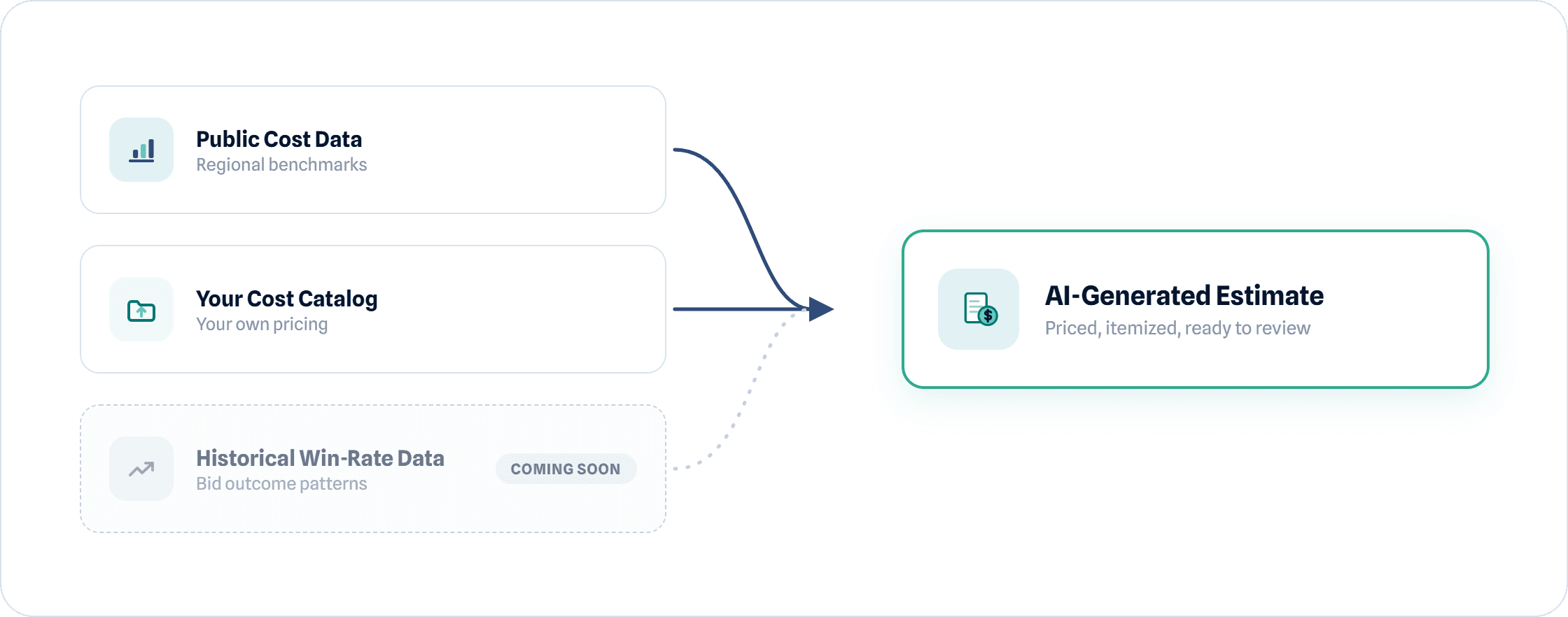
Cost source | Estimator’s own knowledge/quotes | Public cost data + your own cost catalog |
Time to first draft | Hours to days | Minutes |
Consistency across team | Depends on who’s estimating | Standardized against shared cost data |
Editability | Fully manual | Edit/correct, or accept as a starting point |
Where this gets more accurate: you can upload your own pricing, a cost catalog specific to your business, so the estimate reflects your actual supplier costs and labor rates instead of only public benchmark data. Without that, AI estimating tools typically lean on public, locale-based pricing sources (cost indexes like RSMeans and similar publicly available data) to produce a reasonable starting benchmark.
How does AI estimating relate to AI takeoff?
Short version: takeoff comes first. AI estimating prices the scope that takeoff identifies: you can’t accurately price quantities you haven’t measured yet. We go deeper on how these two connect in one workflow here. Read the full comparison here.
What are the risks of AI estimating?
A correct takeoff doesn’t automatically mean a reliable estimate: pricing is where a lot of real-world nuance lives, and it’s a big part of why the contractor stays indispensable in this process, not a step that gets automated away. A few things worth understanding:
It’s easier to get the rate right than the hours right. Whether a carpenter costs $32 or $38 an hour is a smaller error than misjudging how many hours a task actually takes, and that depends on things a public wage number can’t see: site access, ceiling height, occupied vs. new construction, crew experience, how many mobilizations a job requires. Public labor data is also inherently backward-looking; it reflects survey data from months or years prior, not a contractor’s current, fully burdened labor cost.
The takeoff can be perfect and the job can still be underpriced. Difficult access, occupied conditions, phasing, permit friction, required supervision: these costs often live in an estimator’s judgment calls, general conditions, and allowances, not in anything a takeoff can measure from a drawing.
Material pricing is more than quantity times a public unit cost. Exact product and grade, minimum order quantities, freight, local supplier relationships, lead-time premiums: a benchmark can tell you what a nominal unit typically costs; it can’t tell you what your specific supplier will quote you, in that quantity, delivered to that jobsite, right now.
Pricing is a moving, regional target, not a fixed number. Even good regional cost indexes are still an average for that market: they won’t fully capture a local labor shortage, union vs. non-union rates, or how differently commodities like lumber, steel, and copper can move relative to each other in the same period. And there’s a timing gap too: the price today isn’t necessarily the price when a bid expires or materials actually get purchased.
Subcontractor pricing and scope allocation involve judgment AI doesn’t have visibility into. A sub’s quote reflects their current backlog and how much they want the job, not just quantity times rate, and even a correct takeoff still leaves open questions like who provides blocking, who patches after MEP work, or whether demo is included in a replacement line item. Getting the quantities right doesn’t guarantee the cost is allocated to the correct trade or line.
AI estimating prices cost: it doesn’t set your margin. KonstructIQ’s AI estimating doesn’t recommend markup or margin; that stays entirely in the contractor’s hands, applied flat across the estimate or broken down by trade or line item, based on your own business economics. That’s a deliberate line: cost is a data problem AI can help with, margin is a business decision that shouldn’t be automated.